
BJJ Gear & Wisdom | Gear & Training Guide
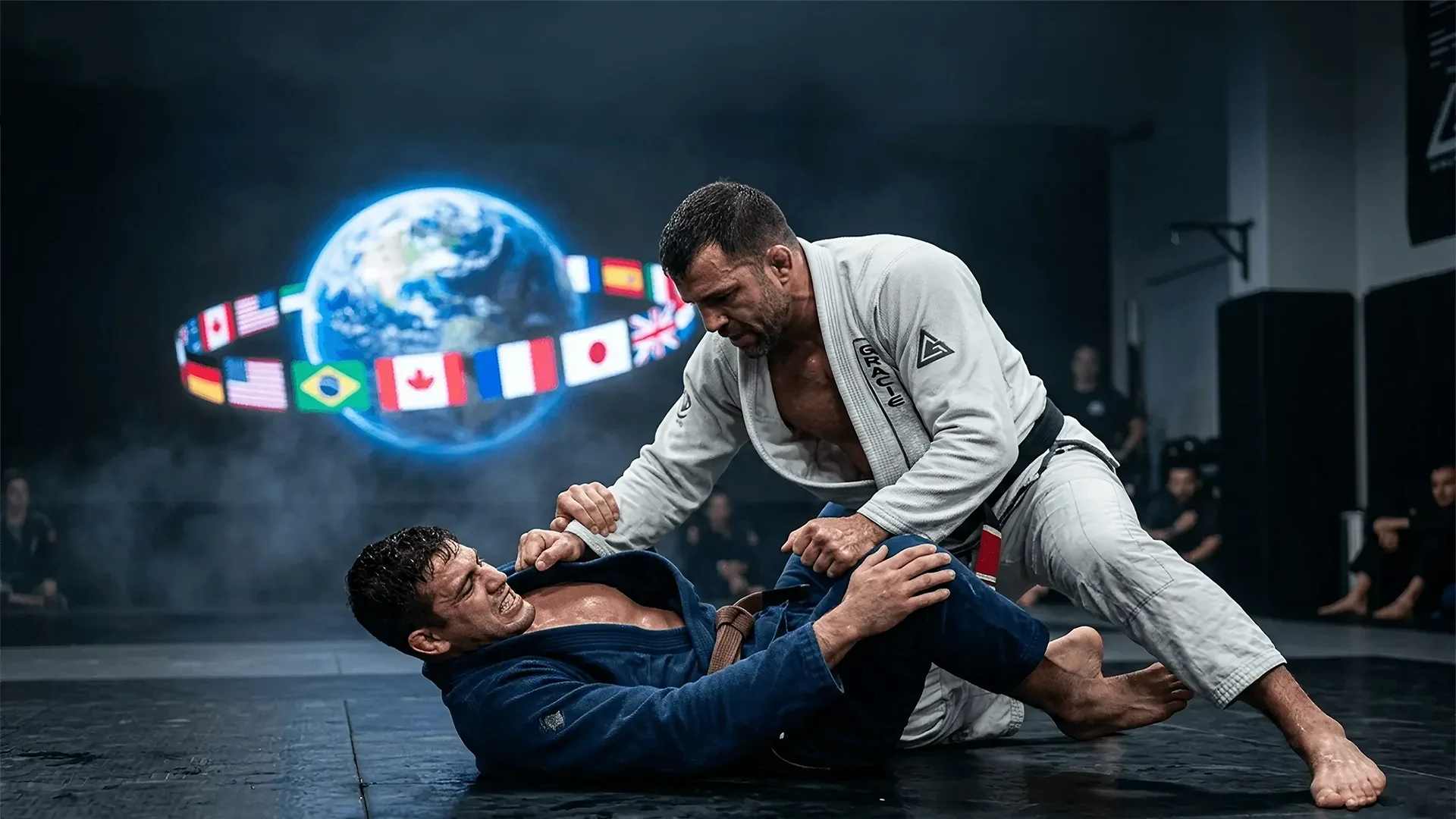
Master the core principles of Brazilian Jiu Jitsu. Explore everything from fundamental techniques and the belt ranking system to the modern training mindset and global lifestyle.
If you’ve already explored our guide Why the Evolution of Jujutsu Still Shapes Modern Martial Arts, then you already understand how Jiu Jitsu evolved from ancient traditions into the modern art we practice today.
For those who haven’t checked out that section yet, we highly recommend it, as understanding the origins, development, and key historical and modern figures provides invaluable insights.
This knowledge not only deepens your appreciation for the system, but also helps you better grasp its current and future potential.
Now, we’ll dive deeper into the essential aspects of this captivating system.
We’ll cover fundamental techniques, ranking systems, benefits, and much more.
Brazilian Jiu Jitsu traces its roots to traditional Japanese Jujutsu and Judo, introduced by Mitsuyo Maeda and other great masters. However, its unique evolution took place in Brazil, thanks to the innovations of the Gracie family and other pioneers. Over time, Brazilian Jiu Jitsu became a cornerstone of modern MMA, with its grappling techniques proving essential in mixed martial arts competitions.
Brazilian Jiu Jitsu, often referred to as BJJ, is a dynamic and highly effective martial art that primarily focuses on ground fighting.
It shares certain principles with wrestling, but emphasizes submissions over pins.
Developed in Brazil, BJJ utilizes sophisticated approaches involving leverage and precise positioning, allowing a smaller and weaker fighter to defeat a larger and stronger opponent.
The true value of this noble discipline lies not in raw physical power but in the intelligent use of the body and mind. This makes it ideal for people of all ages and fitness levels.
Training in this sport enhances coordination, flexibility, and endurance while simultaneously improving mental toughness and self-confidence.
What does intelligent application of body and mind mean? Let’s break it down through some of the most important principles.
💡 Exert only the physical strength that is truly necessary.
This is a fundamental rule, yet it is often overlooked, even by those with significant hands-on experience. That’s why it’s essential to pay attention to this topic first.
The essence of this discipline becomes evident through application, blending both mental and physical aspects.
Mental aspects of this practice include:
Physical aspects include:
A broad understanding of various methods is essential, as it allows you to combine or adapt their elements, giving you many options for defense and attack.
However, you should prioritize movements that suit your body and build your style.
In your repertoire, it’s essential to have signature moves—actions you’ve perfected to the point where you can apply them in various situations with little effort, as they’ve become almost an automatic response.
Strength, endurance, speed, and agility (the ability to make quick, precise movements) are essential for executing techniques effectively and lasting longer in fights.
However, depending on your age or physical limitations, there are adapted methods and styles that remain highly effective. I’ll talk more about this later.
The main goal is to understand these concepts before diving into specific advice on online courses and other recommended resources to help you progress faster and with better quality.
First, we need to master the theory and understand the essence of what we’re doing. Without understanding, any application will likely lead to mistakes, just as theory without hands-on experience remains only theory, which may fail in real-life situations.
💡 Theory combined with practice is the key to success!
Coordination, balance, and reflexes are crucial for correctly performing the technical elements of combat sports.
However, if you’re older and your reflexes aren’t as sharp as they once were, that doesn’t mean training is pointless.
You need to align yourself and approach training strategically, giving yourself enough time to develop timely, coordinated, balanced, and appropriate responses.
Everything I’ve listed, essential for effective execution, is often neglected when encountering resistance.
In response to immediate challenges, physical strength becomes the primary focus at the expense of technique. This reaction negates the art’s core principles and is the first thing you must overcome.
Often, the desire to avoid losing control takes over. Instead of adjusting your body position to turn your opponent’s mistake into an advantage, people often resort to brute force and uncoordinated movements. Let’s highlight these facts by learning or revisiting the principles necessary for mastery.

Kuzushi (崩し) is a Japanese term for martial arts such as Judo, Aikido, Brazilian Jiu Jitsu, and others.
This term refers to breaking the opponent’s balance before executing a throw, sweep, or other attack or defense move.
💡 When your opponent pushes—pull; when they pull—push!
Why is this principle effective?
Mistakes are inevitable if you lose focus while applying or adjusting a technique, whether in sparring or real-life conflict situations.
In my early days of practicing Brazilian Jiu Jitsu, even though I understood these universal principles from years of studying various martial arts, including ground moves, I will never forget one of my first BJJ sparring sessions.
Here’s what a fight looks like when ego takes the lead instead of wisdom — and the principles are ignored.
My friend, who had heard about this discipline, attended a seminar where he experienced the power of Brazilian Jiu Jitsu firsthand, sparring with Professor Aldo “Caveirinha” Januario, a fifth-degree black belt.
During our sparring session, I weighed around 80 kilograms, while my friend, standing about 2 meters tall and weighing 130 kilograms of muscle in peak condition, posed a serious challenge for me.
But not for Professor Aldo.
That 50-kilogram difference and his much greater knowledge of ground fighting made me feel like I was stuck in a washing machine’s spin cycle—crumpled and half-wrung out, as if the programs had glitched and were indecisively switching back and forth, restarting over and over again.
I felt utterly helpless against his physical dominance and technique—and to this day, I still remember that feeling of total hopelessness.
My determination to avoid submitting for as long as possible put me in a state that’s hard to describe—a mixture of stubbornness and desperation. It was a battle against invisible forces, which over time would take form, transforming through experience into almost tangible contours of the correct paths and shortcuts, with fewer dead ends and wrong turns.
Finally, his voice broke the absurd situation.
With tears streaming down his face from laughter, he struggled to say: “Stop, brother, please—you’ve won!”
Returning to reality, I realized my forearm muscles had cramped so much that I could barely release the lapel of the gi I had been pulling with all my might, unaware that the gi I was pulling was actually my own.
Proper breathing is another key aspect of this mosaic and directly impacts performance, endurance, and overall efficiency during training and competition.
(I’ll be adding a link here in the future with my recommended resource for learning more about this topic.)
➝ Inhale during less intense phases of movement.
➝ Exhale during exertion, attacks, or explosive actions for added power.
Why is mastering skills and paying attention to details crucial in this sport?
On the tatami, athletes engage in technical drills, sparring, and situational exercises designed to prepare them for real battle scenarios.
Each technique is explained in detail and practiced repeatedly, from simple transitions between positions to complex joint locks and chokes.
This kind of environment allows you to develop a detailed view of each movement’s purpose, helping you execute with precision—especially when under pressure.
This methodology ensures that practitioners gain a profound understanding of every element of ground combat.
Brazilian Jiu Jitsu is not just a martial art; it is a life philosophy that promotes continuous physical and mental improvement.
This mindset has helped many UFC champions become legends by blending mental resilience with elite grappling tactics.
Through discipline, patience, and consistency, athletes learn to overcome obstacles on the tatami and in everyday life.
Its effectiveness is evident in MMA, where fighters of various backgrounds integrate BJJ techniques to dominate ground exchanges and apply submissions. As a key component of mixed martial arts, BJJ has influenced the grappling strategies of countless professional fighters.
Whether you’re just starting your journey or preparing for the 2025 IBJJF World Championship in Long Beach, staying committed to the fundamentals remains the cornerstone of long-term success.
These are just a few of the key principles we will further explore, for which I will provide links to resources that I find most helpful so you don’t get lost in the sea of information.
If you adopt even just these principles, your experience will improve significantly.
Don’t worry; this is just the beginning, and we will cover many more valuable topics for those who seek quality progress.
However, remember that you will never achieve top results if you don’t embrace the principles outlined here.
Let me put it this way — with time and practice, you’ll likely adopt most of these principles naturally. But by applying them intentionally from the start, you can save time, build momentum faster, and gain a real edge over those unaware.
💡 A technique done a thousand times incorrectly is still incorrect.
Here’s a personal example that demonstrates how these principles work in practice:
At a Real Aikido seminar, while exploring a technique with a colleague, we found ourselves momentarily confused due to our differing interpretations—even though both his and my variations worked for us.
Imagine stretching your arms to the sides—this represents the neutral phase.

When you swing to strike with anything (a slap, knife, or baseball bat), the motion enters the minus phase, as the force moves away from your opponent and loses all its power.
However, when you swing toward your opponent and pass through the neutral phase, the force only increases as it approaches them—this is what we’ll call the plus phase.
I argued that it’s best to intercept the arm in the minus phase, as it has less power, and I can more easily manipulate the opponent’s arm and throw them off balance (kuzushi).
My colleague suggested that it is better to intercept the arm in the plus phase, as redirecting that force would make it easier to throw the opponent off balance.
We then asked Master Bratislav Stajic, an exceptional Aikido expert and holder of an 8th-degree black rank.
He told us that neither of us was right.
The right moment is when the arm is in the neutral phase!
If you intercept the arm in the neutral phase and pull to the side, you’ll shift the opponent’s entire body weight onto one leg while the other remains in the air, making them completely powerless, regardless of their strength.
Stand up, stretch your arms out, and imagine someone pulling your left or right by the arm. You’ll understand what I’m talking about no matter how you distribute your weight and position your feet.
I shared this story because, although that seminar took place in 2009, almost 16 years ago, I’ve never forgotten that lesson.
This is why exploring the correct paths and learning from the best while practicing with those you can train with is essential.
If you haven’t already, adopt these four principles and observe how miracles happen.
Engaging in this ground-fighting sport offers many benefits that extend far beyond the tatami. No matter your body type or size, the leverage-based mechanics of BJJ make it highly adaptable to individual capabilities.
It’s not just about staying active; it’s a path to the comprehensive development of both body and mind.
Here are some key benefits you can expect.
This approach offers an intense, full-body workout that engages all muscle groups. Regular training enhances strength, endurance, and cardiovascular performance. You’ll become stronger and more resilient through various technical drills, sparring, and conditioning exercises.
This approach requires a high level of mobility for the effective execution of moves and transitions between stability points. Regular practice enhances flexibility, improves performance on the mat, and reduces the risk of injury in everyday life.
Of course, depending on your age, individual predispositions, and whether you want to pursue it professionally or as a hobby, you will choose movements adapted to these factors. The capacity to adjust strategies to individual needs and abilities while retaining their effectiveness is another beauty of this pursuit.
Like many dynamic systems, this way of life provides an outlet for daily stress and tension. The physical activity and focus on skill execution assist athletes in releasing negative energy and finding inner peace.
Sparring and workouts in a controlled environment allow for safe and constructive relaxation. Understanding the moves and dynamics keeps the mind fully engaged during sessions, which in itself offers relief from everyday life’s challenges.
Achieving success in this sport requires dedication, regular exercise, and patience. Athletes learn the value of persistence and continuous effort, which translates into other aspects of life.
Consistency and respect are also required to progress through the belt system and develop true technical mastery. The structure provided by this method supports practitioners in reaching goals and overcoming challenges.
Mastering new methods and progressing in the ranking system significantly contributes to developing personal assurance. Every small victory in the gym builds a sense of individual worth and security.
This global phenomenon is not just about the body but also a mental game. It develops mental superiority through strategy, tactical thinking, and the capacity to stay calm under pressure.
This mental toughness is essential—not only for success in battle but also for managing daily stress and challenges.
Sessions often involve working in pairs or groups, fostering a sense of community and friendship. New students are encouraged to join team drills and positional sparring to build comfort and coordination.
Mutual support, learning, and growing together create a strong and positive environment. Practicing this way of life offers a holistic approach to health and well-being, improving overall fitness, mental resilience, and social connections.
It is much more than just a sport; it’s a way of life that inspires individuals to become the best version of themselves and confidently face life’s challenges.
Training in this ground-fighting sport is a complex, multi-layered process that combines conditioning, technical skills, and mental discipline.
Today, many professional MMA fighters rely on BJJ techniques as a strategic advantage during grappling exchanges inside the cage.
Competing in a BJJ championship is an actual test of skill, endurance, and mental toughness.
Each session is structured to enhance your abilities through key components. Many top-tier academies host international training camps, allowing students to learn from world-class instructors.
International tournaments also allow practitioners to test their skills against a diverse field of competitors, pushing their limits in a highly competitive environment.
The foundation of every workout is technical drills. These drills involve precise learning and repetition of key movements, such as transitions between positions, joint locks, and choking methods.
Through these drills, you perfect your movements and gain a deeper understanding of the biomechanics of the human body, enabling you to apply what you’ve learned effectively in real situations.
Competing in these kinds of tournaments gives you another opportunity to apply everything you’ve refined, putting your skills to the test under high-pressure conditions.

Another key element of this system’s methodology is sparring, commonly called “rolling.” During rolling, you can test your skills in a controlled yet realistic environment. Rolling is not just an activity for the body; it’s also a mental game of strategy and tactics, where you constantly analyze and adjust your approach to outsmart your opponent.
Conditioning exercises are also an integral part of this routine. These include various methods to improve endurance, strength, and flexibility.
These exercises are essential for maintaining a high fitness level, allowing you to withstand intense workout sessions and competitions.
💡 Theory without practice is just as ineffective as practice without theory.
The theoretical study of combat strategies makes up the intellectual component of this discipline. It’s essential to analyze different situations and develop plans to resolve them.
This includes understanding when and how to apply specific methods, reading your opponent’s intentions, and adapting to changing conditions during a match.
This mental preparation is crucial for success, as it will allow you to stay calm and focused, even in the most challenging situations.
Following this way of life means embracing a well-rounded path that brings together the conditioning, technical, and mental aspects of contact sports.
Through consistent and dedicated work, you will gain the skills necessary for battle and develop the inner stability and confidence needed to face challenges in everyday life.
As you continue to train, you’ll notice that mental clarity and body awareness become sharper both on and off the mat.
This journey is one of continuous improvement, where each step represents a new challenge and an opportunity for growth.
Unfortunately, in some clubs, not enough attention is given to warm-ups and stretching. If you are in such a club, where warm-ups are minimal and may consist of repeating moves from the previous session, I suggest doing what I used to do in these situations.
I would arrive half an hour early and start my warm-up by running (if there was enough space) or doing cardio exercises on the spot.
After these exercises, when the body was warm, I would warm up all the joints, starting from the neck, shoulders, and down to the ankles. Then, I would follow this with stretching.

Afterward, I would perform technical movements on the ground, practicing different forms of motion necessary for ground combat.
This preparation ensures that your joints and muscles are ready for more extraordinary efforts, reducing the risk of injury.
💡 Take care of your physical well-being by preparing for the effort ahead because your health should always be the priority.
This is one of the best pieces of advice I can give:
💡 A proper warm-up and stretching routine should be a non-negotiable part of your training schedule.
The basics of Brazilian Jiu Jitsu form the foundation for every practitioner, regardless of experience level.
Understanding basic setups is crucial for developing an effective fighting strategy. Each grappling scenario has specific methods and tactics that allow a fighter to take command and dominate in a match.
As I mentioned before, I’ve been studying martial arts for over forty years, and I can tell you that it’s rare to find individuals who are genuinely dedicated to the details.
Diving deep into any field is undoubtedly a significant challenge.
When you hear people who have lived in a foreign country for a decade or more still struggling with grammar and accent, it’s a clear example of the challenges I’m referring to.
They face mastering countless words, grammar rules, and slang, so many are content with communicating without focusing too much on the details.
It’s quite similar in the world of martial arts.
The overwhelming number of so-called school techniques, transitions between positions, lack of conditioning, and thousands of technique variations present a challenge. As a result, most people are content to enjoy training without paying much attention to the details.
Bruce Lee is one of the clearest symbols of dedication and discipline in martial arts.

💡 “I fear not the man who has practiced 10,000 kicks once, but I fear the man who has practiced one kick 10,000 times.”
In this famous quote, Bruce Lee emphasizes the importance of repetition and mastering a smaller number of moves, which can be far more powerful than knowing many techniques superficially.
This is another crucial piece of advice I can offer you.
It’s logical but often not practiced. People are too shy to ask questions for fear of being laughed at or creating an uncomfortable situation.
I’ve gone through this repeatedly, but I never stopped asking questions since it’s one of the fastest ways to gain new perspectives.
Watching high-level BJJ matches on YouTube can provide insight into advanced techniques and competition strategies.
Renzo Gracie’s classic matches are a great source of both inspiration and technical depth, especially in pressure-based passing.
To improve faster, follow elite athletes who compete in major events like the ADCC or UFC and analyze their strategic transitions during ground fights.
Another great way to learn is through recorded courses from verified instructors whose expertise many of us would never have access to if it weren’t for the internet—something I didn’t have when I was younger.
Many grapplers use search engines to find instructional videos, competition footage, and training advice. But you need to be very careful when choosing what to follow—and that’s where I come in.
There’s an old saying: “Insanity is doing the same thing over and over again and expecting a different result.”
The real challenge is overcoming ego-driven blocks—or whatever you want to call them—that stop people from asking for clarification.
Even when their mistake is pointed out, they resist accepting it and try to justify themselves, just to avoid feeling inadequate or unfamiliar with the topic.
Don’t be one of those people if you want to achieve great results.
You’ll encounter people, from white to black belts, who will try to convince you that you’re wrong.
Therefore, it’s important to research from multiple sources and not take anything as absolute truth.
Rank and titles are not always awarded purely for perfect technique but also for consistent dedication and commitment.
So, as happened to me, you might hear two high-ranked black belts give two different explanations for the finish of a choke.
I accepted the explanation that made more sense and whose perfectionism was undeniable. I’ll recommend him to you during this journey.
I mentioned school techniques, so let’s discuss this concept because it’s essential to understand.
School methods are designed to be functional if you follow all the principles I’ll describe in this and future sections.
You’ll be able to see examples through courses. However, you’ll often find that you can’t execute a school method during a fight or sparring with someone who understands this system, and often not even in self-defense.
Most commonly, what happens is a combination of elements from these school methods and smooth transitions from one movement to a completely different one.
But to navigate these waves coming at you from all sides, you need to understand the details of the movements and recognize the moment when your opponent makes a mistake in their execution.
At that moment, you can capitalize with a counterattack or defense. In this game of outwitting, the one who strives to understand the importance of these principles will prevail.
Every person is different in character, inclinations, intellect, physical predispositions, and experience, meaning each of you will develop a unique fighting style, refining methods that suit you best or inspire you the most.
💡 Just like in life, your style will be unique.
💡 Don’t perform techniques too fast or too slow.
A common mistake is the desire to perform a technique quickly, thinking it will look more powerful.
When learning a technique, the first goal is understanding the steps involved. I advise breaking down the steps to understand the movements and exploring slowly so you don’t hurt yourself or your partner.
Then, once you’ve figured out how it’s done, try to execute it without breaking it up—perform it from start to finish as slowly as possible.
Avoid classic mistakes like rushing through the parts you’re confident in and then hesitating or pausing when encountering something unfamiliar. The technique should be fluid but performed at a pace that allows for functional movement and time to think.
If you perform the technique too slowly, it won’t work, and if you perform it too quickly, you won’t notice where you made a mistake—and you may never correct that mistake.
When you encounter a stoppage during the execution of the technique, don’t start over from the beginning.
💡 Stop at the point of difficulty and explore or ask questions.
Once you can perform the technique fluidly from start to finish, you can gradually increase the speed—but carefully, maintaining complete precision to prevent injuries to your sparring partner.
Ask your sparring partner if they notice any mistakes; this is extremely important for your mutual progress.
However, when you encounter a partner with whom communication isn’t harmonious or productive—or, to be blunt, someone who always thinks they know better—remember my words and don’t waste energy explaining, even if you’re sure you’re right.
Such people will never listen, and they’ll take your well-meaning advice as an attack on their intellect.
Draw your conclusions and listen to what they say, and don’t avoid accepting good advice just because someone else is not doing so.
Thankfully, there are people with whom it’s a pleasure to work, but you won’t get far if you only wait for such practice companions.
Until you reach the point where you are completely confident in your sense of control, my advice is that even when you speed up a technique, do so only up to the point where the lock begins, and then stop and execute the finishing move slowly.
This is a surefire way to ensure that you never injure anyone, which should be your top priority.
I’ve had numerous sparring sessions with white belts who weigh up to 130 kilograms and have been practicing for several months.
They are already aware of enough to perform a technique, but they still don’t fully understand the significant weight difference, nor do they realize that when they apply a joint lock, even if someone is resisting, it could be a matter of split seconds before the defense weakens and the lock is applied.
They often charge in with all their strength, and when the defense gives way, they won’t even be able to stop the force, because the moment the resistance collapses will surprise them.
Don’t do this to others—be aware of what I’m telling you.
If someone is doing this to you, be prepared to tap out early, even if the lock hasn’t fully been applied yet.
You’re all there to learn, and if they don’t understand that, make sure you do.
We will discuss grappling scenarios and finishes in more detail later, but for now, I will list some of the most important setups to give you an overview of the safest starting points.
Lorem ipsum dolor sit amet, consectetur adipiscing elit. Ut elit tellus, luctus nec ullamcorper mattis, pulvinar dapibus leo.

Guard is one of the most basic and vital positional points in BJJ. In this setup, the fighter lies on their back while managing the opponent with their legs and arms.
There are many variations of the guard, including closed guard, open guard, half guard, spider guard, and many others.
Each variation has specific moves that allow the fighter to attack, defend, or transition to a more favorable grappling scenario.
The guard is key to neutralizing attacks and setting traps for the opponent.

The mount is a dominant position where the fighter sits astride the opponent’s torso, usually around the stomach or solar plexus area, allowing for strong control and a wide range of attacks.
The fighter can deliver strikes, apply chokes, or transition into submissions like arm locks from this position.
Stability and balance are crucial, as the opponent often tries to escape or reverse the position. Mastering the mount is essential for maintaining dominance and creating opportunities to finish the fight.

This position is one of the most dominant options, offering the fighter numerous opportunities for attack.
In this scenario, the fighter lies sideways on the opponent, using weight and pressure to maintain control.
This setup allows for transitions into other dominant positions, such as mount or north-south, and executing finishing moves like joint locks and chokes.
The key to success in this situation is maintaining pressure and preventing the opponent from escaping.

This dominant position is considered the most desirable in ground-fighting sports, providing numerous opportunities to finish the fight.
In this scenario, the fighter is positioned behind the opponent, using their legs and arms to manipulate and execute various techniques.
This setup is extremely powerful because the opponent has very few escape options. The rear naked choke is one of the most effective submissions that can be applied from this advantageous position.
Maintaining steadiness in this situation requires precision and a strong sense of balance.
Understanding and mastering these fundamental setups provides a solid foundation for further progress in this discipline.
Each positional point carries a set of methods and strategies that allow the fighter to take the initiative and dictate the flow of the fight.
Through consistent drilling and repetition, athletes develop the skills necessary for effective dominance over their opponent, making this system a unique and highly effective approach to combat.

As we slowly familiarize ourselves with important principles on each page, you might think they are only meant for beginners. However, you’ll notice through training that many practitioners, regardless of belt rank, fail to adhere to many of these principles, even though they are entirely logical.
Understanding and applying these universal principles—or neglecting them—makes a huge difference in the quality of your skills, as well as in your overall improvement and progress in grappling.
Now, I will present the ranking system. It’s important to understand the basics of what you’re practicing and to be able to confidently answer questions about it.
In the future, I will dive deeper into most of these belts, the approach to skill development, and the challenges that await you at each level.
Ranking in Brazilian Jiu Jitsu differs from many other martial arts, offering a unique system that reflects a practitioner’s growth in skill and experience. The International Brazilian Jiu Jitsu Federation (IBJJF) is the leading organization responsible for standardizing belt rankings and governing competition rules in the sport.
In BJJ, the belt system for adults consists of the following colors, from beginner to master level:
Above the black belt, there are additional ranks for highly experienced and distinguished practitioners:
Children also go through their belt system before transitioning to the adult ranks. This system includes the following colors:
When children reach the green level, they typically transition to the adult ranking system, starting with the blue belt.
Progressing through the ranking system requires children to maintain regular attendance, consistent effort, and respectful behavior, which also encourages positive habits over time.
This is the beginner level. Students at this stage learn the basics, including fundamental methods, positions, and combat rules. During this phase, the focus is on gaining a foundational understanding and developing the flexibility needed to perform key movements. This beginner rank symbolizes purity and the beginning of a journey in the world of grappling.
The next step in a practitioner’s development. At this stage, practitioners develop a deeper understanding of fundamental methods, and more complex movements are introduced. The blue rank signifies that the practitioner has mastered basic concepts and is ready for further progress. During this phase, grapplers refine their style and strategies, often through more intense sparring sessions.
Represents an intermediate level of skill. Grapplers with this rank have a solid grasp of techniques and begin to develop their tactical awareness. The purple rank marks the transition from fundamental skills to more advanced strategies and adaptations to various fighting styles. At this stage, students often take on the role of mentors for less experienced team members.
The gateway to mastery. Students at this level possess a high degree of technical skill and tactical awareness. The brown rank signifies that the fighter is capable of executing advanced moves with precision and efficiency. During this phase, the emphasis is on refining details and preparing for the black rank. Brown ranks often assist in leading group classes and help develop their teammates.
Symbolizes mastery and a deep understanding. It is not only a sign of expertise but also of dedication, discipline, and contribution to the submission-based art. Those at this level often become instructors, leading academies and coaching the next generation of fighters. Achieving this rank is a journey that demands significant dedication and is filled with learning, hard work, and continuous development.
Also known as the coral rank, individuals at this level typically have at least 30 years of active involvement and have significantly contributed to the development and promotion of the sport. Instructors at this level are highly respected and recognized as leading masters and teachers.
Holders of this rank are even more experienced and recognized for exceptional achievements within the close-combat family. This level requires at least 35 years of dedicated development and contribution to the sport. Often referred to as the second-level coral rank, its holders are highly respected instructors with significant influence.
The term coral rank is an informal name for the black, red, and white ranks (7th and 8th degrees). These ranks represent the transition between the black and red ranks and are worn by individuals who have dedicated decades to instruction, teaching, and spreading this discipline.
The highest level in this sport, awarded to exceptional masters who have trained and promoted the discipline for over 40 years.
A holder of the 9th degree is often a pioneer in developing this practice, while the 10th degree is reserved for the founders, such as Carlos and Helio Gracie (originally spelled Hélio).
This rank represents the pinnacle of dedication, knowledge, and contribution to the ground-fighting world.
Advancing through the ranks in this discipline requires patience, dedication, and continuous improvement. Belts are awarded based on proficiency, ensuring that practitioners meet technical and competitive standards before progressing. Each rank represents a new phase of learning and personal growth, where athletes refine their technical skills and develop mental strength and character.
The ranking system is a journey that inspires every practitioner to become the best version of themselves, both on the mat and in everyday life.
The word Oss is used not only in the Brazilian Jiu Jitsu community but also in many other martial arts of Japanese origin, such as karate, judo, and aikido. This word is an abbreviation of Onegai shimasu, which can be translated as a request for permission to begin training or engage in combat while expressing respect toward a partner or instructor.
In karate, for example, Oss is often used to show respect, acknowledgment, or as a response to an instruction or compliment.
In judo and aikido, it is also applied in similar contexts, symbolizing respect and dedication. The adoption of the word Oss varies depending on the school and style, but generally, Oss is widely accepted and incorporated into various martial arts with Japanese roots.
In BJJ, “Oss” is used as a sign of respect between teammates and instructors and among the fighters themselves. When we enter the dojo, greet the instructor, or finish the exercise, the word “Oss” symbolizes our respect for the people we share the tatami with and the art we are learning. This respect is formal and essential, reflecting a deep gratitude for the opportunity to learn and grow together.
This discipline demands dedication and consistent effort to achieve mastery.
Through regular drills and applied experience, practitioners develop the patience needed for progress.
“Oss” serves as a reminder that the path to the black belt is long and full of challenges, but with patience and perseverance, every step brings us closer to our goal.
Perseverance is a key value. Every workout session, every sparring round, and every challenge presents unique obstacles. Students often have to overcome physical and mental barriers, but with perseverance, they can surpass any hurdles. ‘Oss’ is an expression of unwavering determination, a readiness to face difficulties and not give up, no matter the circumstances.
“Oss” is more than just a word; it’s an expression of the fighter’s spirit that strives for constant improvement and self-betterment. When we say “Oss,” we remind ourselves of our goals, the discipline we practice, and the determination to give our best, whether in training, competition, or everyday life.
The BJJ family is known for its unique camaraderie and mutual respect. Incorporating the word “Oss” helps strengthen these bonds, reminding grapplers of the importance of support, cooperation, and positive energy. Regardless of skill, rank, or experience differences, “Oss” connects us as members of the same martial arts family.
In essence, “Oss” is a comprehensive word that encapsulates the core of Brazilian Jiu Jitsu. It represents a combination of respect, patience, perseverance, and fighting spirit, forming the foundation for a healthy and productive community. Through the regular use of “Oss,” grapplers are reminded of the values essential for their progress, both on the tatami and in everyday life.
Ossssss!

Brazilian Jiu Jitsu is renowned for its fight-ending techniques, called submissions. These moves represent the goal, allowing fighters to force their opponents to submit using precise and effective strategies. Submissions include joint locks, chokes, and other methods that, when properly executed, neutralize the opponent without the need for additional violence.
Joint locks, or “locks,” use leverage to create pressure on the opponent’s joints, forcing them to submit to avoid injury. The most widely recognized locks include the armbar (elbow lock), kimura (shoulder lock), and omoplata (shoulder and arm lock). These submissions are effective since they allow the fighter to control the opponent and force them to submit.
Chokes restrict the flow of air or blood to the brain, forcing the opponent to submit.
The most well-known choke moves include:
Therefore, the guillotine is not strictly a blood choke, as it often affects airflow as well.
These moves are particularly effective because they allow quick and safe restraint over an opponent.
This discipline includes joint locks and chokes as well as other submission methods such as wrist locks and leg locks. These techniques add variety to a fighter’s arsenal, allowing them to adapt to different situations and opponents.
Executing submissions requires precision, patience, and a detailed understanding of the human body’s biomechanics. This is why BJJ is widely utilized in MMA, where fighters rely on its efficiency to control opponents and secure fight-ending techniques.
Through consistent preparation, athletes can identify and capitalize on opportunities to finish the fight, whether in competition or real-life self-defense. Submissions are essential to this way of training, symbolizing its philosophy of efficiency, control, and non-violent conflict resolution.
Practicing submissions improves technical skills and develops mental toughness and the capacity to make quick decisions. Every successfully executed technique results from patient learning and adaptation, making this method an extremely valuable and practical approach in everyday life.
These non-violent submissions and regular sparring, combined with the many times proven superiority that grappling practitioners demonstrate, are the reasons for my recommendation and love for this discipline.
As I’ve said before, theory without practice is as worthless as practice without theory, and that’s why we’re learning theory here. Once you experience a quality sparring session, I guarantee you will fall in love with this pursuit because it is more than just a sport or combat system.
I trained Aikido for years, but to simulate sparring, it requires two highly skilled martial artists to avoid injuries. I’ve also trained in full contact and boxing, where sparring is regular, and the progress is relatively quick—but so are the injuries, and the pain is constant.
This system is not only fun, but you can also progress rapidly if you follow my advice and watch the courses I recommend.
Regular sparring will clarify whether you can execute submissions on someone, and you’ll always have a precise understanding of where you stand.
To start your journey, visit a certified academy and ask about their beginner programs — many offer a free trial class or a few training sessions at no cost.
If you follow the advice I’m about to list, you’ll never injure your own body or others:
Avoid uncontrolled movements.
Your attention should always be on not injuring yourself or others and only then on everything else.
Don’t attempt techniques or finishes in sparring that you’ve seen but haven’t trained with consistently or fully understood.
Be prepared to tap out during sparring, even if the submission isn’t fully locked, if there’s a significant danger of injury.
In this section, I would round off with the advice that if you’re a beginner and adrenaline kicks in—meaning you haven’t followed one of my previous pieces of advice (which happens regularly)—when you reach a submission, slow down and try to finish the technique without using too much force, even at the cost of losing the position.
It’s clear that everyone loves the taste of victory—it’s sweet and tempting. But constantly keep in mind that your purpose on the mat is to learn methods that allow you to finish with as little force and effort as possible, whether against a sparring partner or an attacker in a personal protection scenario.
That’s why it’s called technique, and the goal is to become a good technician, so that even if you’re a woman, you can easily defeat an attacker who’s 30 kilograms heavier and physically much stronger than you.
Maybe this all seems so logical to you now that you wonder why I’m going into such detail.
More often, you’ll end up in sparring sessions where, as soon as your opponent realizes they can’t beat you with technique, they’ll start using more and more force.
That’s ego, that desire to win, that human instinct you must fight against if you want to learn how to defeat many opponents with submission techniques.
And when you meet a sparring partner who plays with you like a child, who has an answer to every move you make, and you feel like they’re using almost no force—yet still managing to submit you—you’ve found someone who not only understands these principles but also follows them.
Sparring with such individuals is a pleasure, and someone who doesn’t practice this art wouldn’t even realize what hit them if they were to attack such a technically skilled fighter.
That should be your goal, and only a proper drilling approach will bring you to the point where you can apply submissions from any position with surgical precision and without excessive force.
Winning in rolling by using too much force because you couldn’t complete the technique properly doesn’t mean your technique is good, even if you managed to win. It just means your opponent’s technique was worse, and you didn’t learn what the problem was or how to solve it.
When you face someone better or physically stronger, you won’t be able to finish them because your ego didn’t allow you to learn when you had the chance.
Only when you understand and accept this will your progress become extremely rapid.

Open Mat in Brazilian Jiu Jitsu is a unique opportunity for students to gather at the academy and train in a relaxed, informal setting.
Many academies offer free access to Open Mat for first-time visitors, giving you a chance to explore different training styles, get a feel for the atmosphere, and work on techniques you struggle with—such as closed guard, lasso guard, or X-guard—without any pressure.
During such sessions, no strictly defined program or instructor leads the practice. Instead, fighters can practice moves of their choice, spar with different partners, and exchange experiences.
These gatherings offer flexibility not present in standard classes. Grapplers can concentrate on specific skills they want to perfect, repeat movements that give them trouble, or experiment with fresh strategies. This freedom allows for a personalized approach to exercise that suits each fighter’s individual needs.
One of the most significant benefits of this program is the opportunity to spar with various individuals. This allows students to face a range of tactical variations, different levels of skill, and varying physical abilities. Such diversity assists in adapting and refining their approach in real-life situations.
Open Mat sessions foster a sense of belonging among club members. Practitioners can exchange advice, support each other, and work together to improve their skills. More experienced fighters often mentor less experienced members within the academy, creating a supportive environment for learning and growth.
Without the pressure of a formal class structure, such gatherings offer a relaxed environment where grapplers can concentrate on their progress. It’s the perfect chance to resolve uncertainties, ask questions, and closely study moves with peers.
For those preparing for competitions, this is an invaluable opportunity for extra sparring and strategy practice. BJJ events range from local tournaments to world-class championships, drawing competitors from all over. Students can simulate competition conditions, work on conditioning, and test their skills against various opponents. During Open Mat sessions, participants share a lot of BJJ news about upcoming tournaments and rule changes.
Open Mat is more than just regular training; it is an opportunity for comprehensive improvement, team bonding, and in-depth exploration of martial arts. Whether you are a beginner or an experienced fighter, in your home gym or visiting another club, these sessions allow you to prioritize your goals, connect with the grappling network, and continuously improve.
💡 If you find these tips helpful, be sure to read the full post to discover the deeper context and training insights behind each one.
This section highlights essential Brazilian Jiu Jitsu principles and training habits—perfect for those looking to live the art both on and off the mats.
👉 Continue with tips 69–94: BJJ Lifestyle, Conditioning and Long-Term Growth Tips.
This section explores conditioning, recovery, injury prevention, competition, equipment, and the long-term BJJ lifestyle.
Need the earlier foundation first? See tips 1–47: Jiu Jitsu Life Lessons, Mindset and Training Principles.
These frequently asked questions about Brazilian Jiu Jitsu (BJJ) cover training, ranking systems, mindset, and what to expect when starting your journey on the mats.
Brazilian Jiu Jitsu (BJJ) is a grappling-based combat system that originated from Japanese jujutsu and judo, later evolving in Brazil with a unique focus on leverage, timing, and positional dominance.
What sets this style apart is its ability to help a smaller, technically skilled person overcome a physically stronger opponent through joint locks and chokeholds, rather than brute force.
Unlike striking disciplines like boxing or karate, this approach to combat emphasizes strategy, body mechanics, and calculated movement, making it a top choice for mixed martial arts and self-defense applications.
Training in BJJ includes a mix of technical drills, live sparring (rolling), and conditioning exercises.
A typical session starts with a warm-up, then moves into position-based technique practice, followed by situational sparring or full rolls.
You’ll learn how to transition between positions like guard, mount, and side control, and apply submissions under pressure.
It’s a blend of physical conditioning, mental strategy, and precise execution.
If you’re new to Brazilian Jiu Jitsu, focus on:
These form the foundation of your progression, whether your goal is competition, self-defense, or personal development.
In adult BJJ, ranks go from white to blue, purple, brown, and black. After black, there are advanced degrees including coral belts (red/black or red/white) and finally, the red belt — reserved for legends like Helio and Carlos Gracie.
For kids, the system includes gray, yellow, orange, and green belts, before they graduate into the adult ranks.
Advancement depends on technical skill, consistent training, and instructor evaluation, not just time.
Training BJJ builds:
This system isn’t just about fighting — it’s a way of life that promotes discipline, clarity, and inner strength.
In Brazilian Jiu Jitsu, “Oss” is a respectful phrase used to express discipline, humility, and mutual respect.
Commonly said when greeting instructors or acknowledging training partners, it signals focus and determination.
Rooted in Japanese martial traditions, this simple word reflects the spirit of perseverance and honor that defines the grappling community.
Open Mat in BJJ is an informal training session without a set curriculum or instructor. It’s a chance to:
It’s especially useful before competitions, or when you’re trying to polish your game plan or positional flow.
Many academies even offer Open Mat for free to visitors, so don’t miss the chance to level up.
Brazilian Jiu Jitsu is therapy in motion. It helps with:
This martial discipline teaches you how to breathe through chaos, both on and off the mat.
It’s as much mental as it is physical — and that’s why so many practitioners call it life-changing.
Brazilian Jiu Jitsu is not just a martial art — it’s a journey of self-improvement, where practitioners gain physical fitness, mental toughness, and valuable life skills through their academy experience.
This post is the second installment in a three-part series designed to build a strong foundation that every practitioner, regardless of experience level, can benefit from.
Through these posts, you’ll gain insight into the history, core principles, and fundamentals essential for understanding and progressing in this discipline.
🚀 Next up: Discover how Brazilian Jiu Jitsu sharpens your mind, boosts physical conditioning, and builds discipline, confidence, and life balance — inside and outside the gym.
🛡️ Sharpen your mind as well as your technique — true mastery begins when learning never stops.
📎 Enjoyed this post? Share it with a friend who might find it helpful.
You now understand the foundations of Brazilian Jiu Jitsu — from leverage, timing, balance, and breathing to the key principles that make BJJ so effective.
But technique is only the beginning.
BJJ also changes the way you think, react under pressure, build confidence, handle challenges, and approach everyday life.
👉 Continue with BJJ: A Way of Life
There, you’ll discover how Brazilian Jiu Jitsu influences mindset, discipline, resilience, relationships, long-term growth, and the lifestyle behind the art.
One Step Closer to Mastery
Ossss!